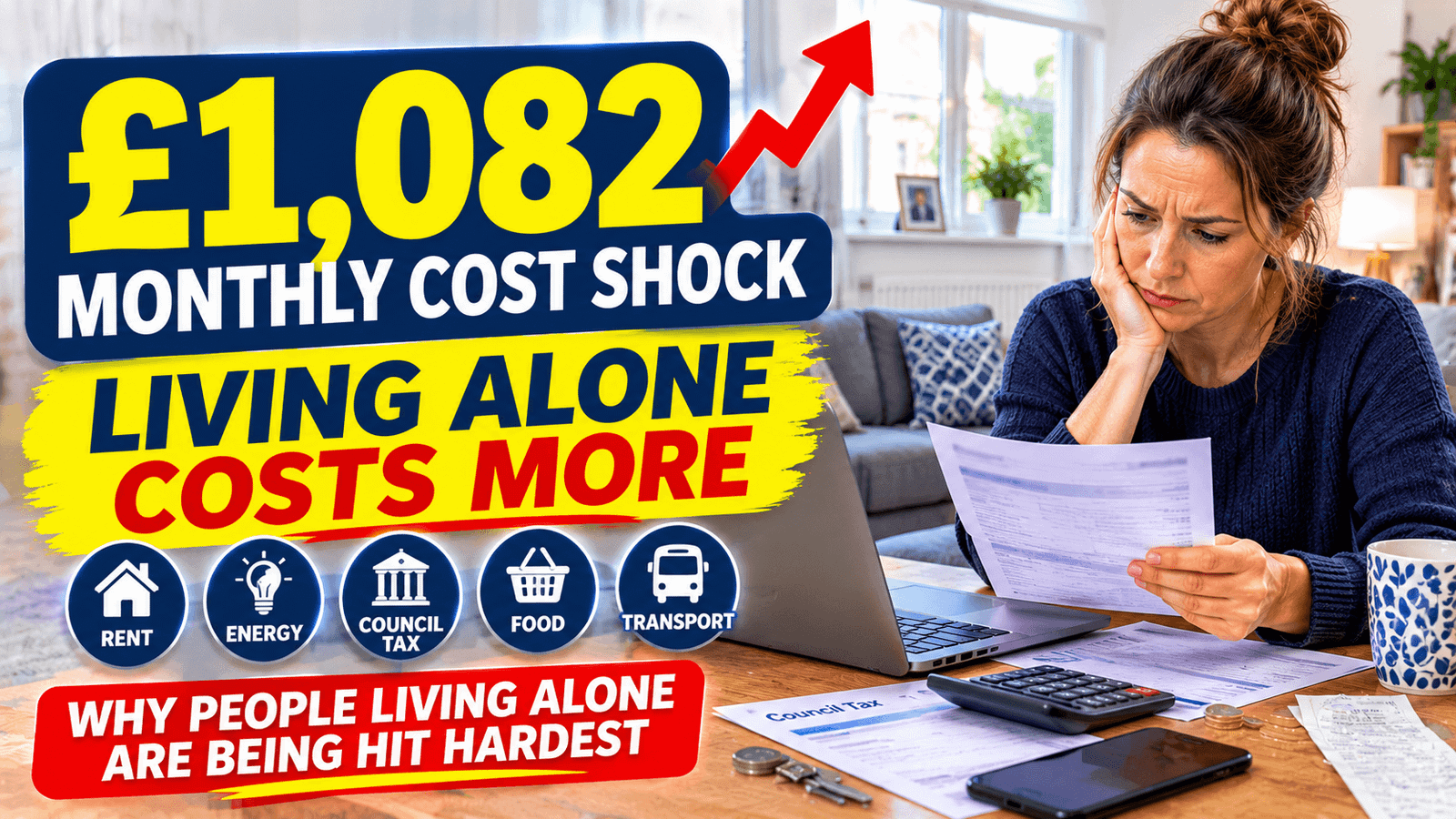
People living alone are facing a growing financial disadvantage because they have to cover household costs without another person to share them with.
New research estimates that single households could face a cost disadvantage of around £12,983 a year, equivalent to approximately £1,082 a month, compared with households where costs can be shared. The figure has been described as a “singles tax”, although it is important to stress that this is not an official UK tax or Government charge.
Why living alone can cost more
Many household bills do not fall by half when one person lives in a property.
Energy standing charges, broadband, insurance, television services and other household expenses still have to be paid by one person. Council Tax can be reduced by 25% for someone who lives alone, but the remaining bill still has to be covered from a single income.
Official figures show that average Band D Council Tax in England reached £2,392 for 2026/27, before any applicable discounts.
Energy bills add further pressure
Energy costs are another major expense for households.
Ofgem’s price cap for a typical household paying by Direct Debit is £1,723 a year from October to December 2026. Actual bills vary depending on energy usage, region and payment method.
For someone living alone, these costs cannot be divided between two incomes.
Research from Aviva also found that people living alone spend around £1,100 per month per person once housing costs are included, rising to almost £1,250 when other fixed expenses such as broadband, mobile phones and insurance are added.
Millions are living alone
This is not a small group. The Office for National Statistics estimates that around 8.6 million people lived alone in the UK in 2025, representing 29.5% of households. Almost half of those living alone were aged 65 or over.
What can single households do?
People living alone should check whether they qualify for the 25% single-person Council Tax discount and make sure it has been applied.
It is also worth checking entitlement to benefits and support such as Pension Credit, Council Tax Reduction and help with energy costs where applicable.
The £1,082 figure should not be treated as a bill everyone living alone will receive. It is an estimate of the financial gap created when household expenses cannot be shared.
For many single households, however, the underlying problem remains the same: one income has to cover costs that can often be spread across two people in a couple household.